***** Ragtime -- extended again!
A spirited refresher course in the vectors that have led us to a new Gilded Age

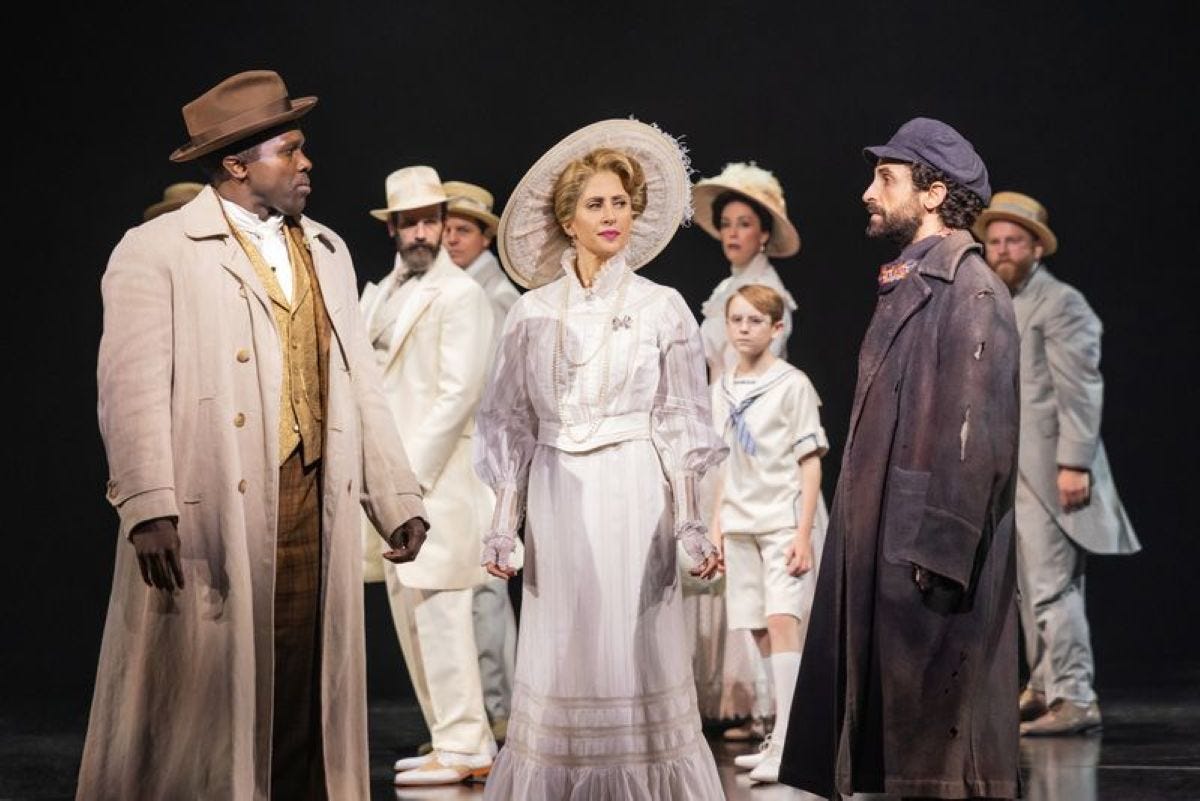
Foreground: Joshua Henry, Caissie Levy, Brandon Uranowitz. Photo: Matthew Murphy
How often in the theatre do you get to witness perfection – or better yet, as is the case with Ragtime, perfection further polished?
At City Center a year ago, director Lear DeBessonet helmed a revival of the impressively pedigreed 1998 hit (book by Terrence McNally adapted from E.L. Doctorow’s sweeping 1975 novel; music and lyrics by Stephen Flaherty and Lynn Ahrens respectively). Speedily assembled, rehearsed, and mounted, City Center revivals perforce have a slapdash quality, but the potential of this production – beyond the astute casting – has now been sleekly funneled onto Lincoln Center’s main stage.
It helps that the arena space offers exquisite acoustics (put to good use by sound designer Kai Harada and music director/conductor James Moore), plus sufficient acreage to permit fluid scene changes (David Korins’s minimalist, allusive sets seem to flow intuitively). There’s a certain symmetry to DeBessonet’s stage pictures: she marshals a cast of dozens with such assurance that the rare pauses between high-intensity scenes afford a welcome opportunity just to drink in the sheer beauty of the compositions.
But there is plenty of action, as admirers of the show come expecting. From the idyll of a typical 1906 morning in bucolic, moneyed New Rochelle, the show lurches to the sendoff for an Arctic expedition, a giddy chorine essaying vaudeville, new arrivals braving scrutiny at Ellis Island, Emma Goldman rallying workers at Union Square, a jam session at a Harlem nightclub . . . and that’s just Act 1.
The threads all eventually coalesce in a charged standoff at a newly built billionaire’s showplace, the Morgan Library (it’s fiction, remember: the real-life target, in 1920, was his bank). As the story unfolds, we’re afforded insights into three seemingly discrete arenas: the sheltered luxe of verdant all-white suburbs, the plight of penniless Jewish refugees, and the thrilling eruption of Black jazz.
As “Mother,” who’s restrained yet bemused, Caissie Levy – in exquisite voice – deftly embodies unalloyed goodness without ever crossing the line into saccharinity.
Michelle Lewis brings a heart-breaking poignancy to the role of young, naive Sarah, who in the throes of postpartum depression abandons her infant in Mother’s garden (here delineated in an enclosure scarcely larger than a shopping cart, the sole silly misstep in staging). Even in recovery – Sarah warms to her child with the song “Your Daddy’s Son” – Lewis retains the posture of a woman repeatedly beaten down by life yet determined to discern rays of hope.
Ben Levi Ross is charming as Mother’s Younger Brother, a quixotic seeker equally fascinated by showgirls (including Evelyn Nesbit, played with ear-piercing squeals by Anna Grace Barlow) and the family business, explosives.
As the Latvian immigrant Tateh, Brandon Uranowitz bristles with the determination of a refugee who has no choice but to start from scratch. Tateh’s concern for his daughter (Tabitha Lawing, a natural) comes across as visceral, his path to success – given his cleverness and enterprise – inevitable. Uranowitz remains playful and charming even after Tateh goes full Hollywood.
Shaina Taub pops in from time to time as Emma Goldman, an insightful commentator when not rabble-rousing (she’s great at that, too), and Rodd Cyrus brings an otherworldly mystique to the role of Harry Houdini.
Counterbalanced – and supported – by all this talent, Joshua Henry reigns as the story’s focal point, Coalhouse Walker, a celebrated (fictitious) jazz pianist subjected to grievous disrespect at the hands of Larchmont’s racist police force. An unforgivable incident precipitates a truly tragic event, enough to set off a saint, and the storyline painstakingly maps out the seemingly unstoppable escalation.
The role has its shadow side (Walker’s means of revenge become arbitrary and scattershot), but Henry manages to take us along on Porter’s vortex of outrage. Henry’s vocal prowess and physical groundedness enable him to elevate this role to heroic proportions. My one cavil would be directed toward the audience: Show some respect and wait for Henry to finish sustaining his extraordinary power notes before leaping to your feet to applaud.
Even with some small, judicious cuts, the running time – nearly three hours – feels a trifle excessive. Some of the “comic relief” material (baseball bros, really?) seems eminently dispensable. But there is one scene that so perfectly embodies the heart of this semi-factual fable, it would be worth reprising as a curtain call.
At the close of Act 1, “Sarah’s Friend” (too emblematic to be accorded a name?) leads a Gospel-tinged anthem, “Till We Reach That Day.” In this near-anonymous role, and up against a massive chorus, Allison Blackwell soars.
That one song would make a great send-off for an audience forced to pick themselves up and recalibrate to our present reality, rendered freshly volatile by a neo-oligarchy seemingly set on sending us back at least a century.
Details: Ragtime. To August 16 [check for cast changes]