
** Monte Cristo
A flat-footed rendering of fabled derring-do

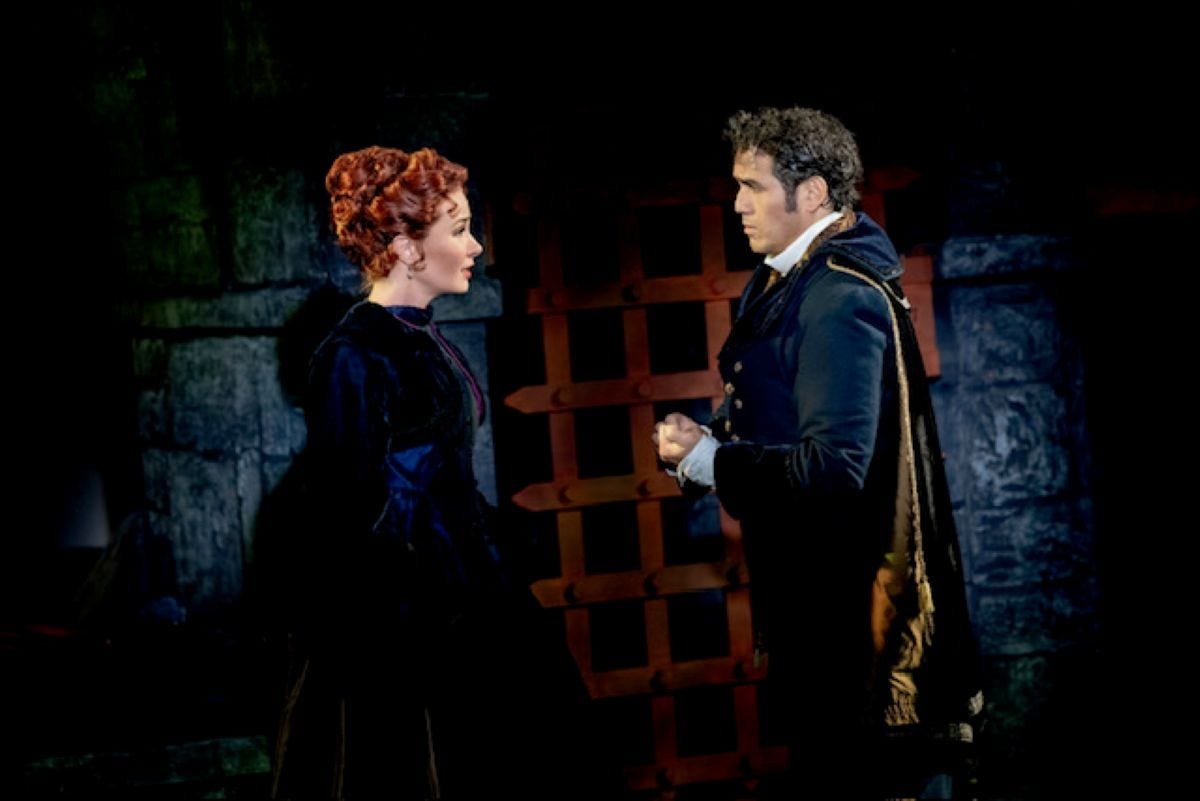
Sierra Boggess and Adam Jacobs in Monte Cristo. Photo: Shawn Saley
Onlookers willing to sit through all two-plus hours of this brand-new but pre-shopworn rendering of Alexander Dumas’s 1844 swashbuckler might find themselves distracted by a puzzling side story: Who in their right mind would shell out big bucks (the staging is lavish) to underwrite such a hackneyed endeavor?
The program accords primary credit to Willette Klausner, whose hitherto stellar track record includes such gems as Maybe Happy Ending. This time she got rooked.
The production values (dungeon/hôtel particulier set by Anne Mundell, lurid lighting effects by Alan C. Edward) are top of the line, and the cast couldn’t be more stellar. Marquee names include Sierra Boggess, Norm Lewis (underutilized here), and Karen Ziemba.
New to me – and a scene-stealing standout – is Danny Rutigliano, who shoulders two roles: that of the imprisoned count-to-be’s scholarly aged cellmate and, passim, an impish tippling innkeeper. Think Les Mis because book writer/lyricist Peter Kellogg clearly did. Ziemba plays a disdainful but secretly fond Madame Thénardier clone – a nag with a yen for gold.
As Mercedes, Boggess is saddled with an assortment of elaborate wigs (credited to Caitlin Malloy), all in a lurid carmine hue not found in nature. Despite being thus encumbered, and required to undergo bouts of melodramatic angst, she sings as exquisitely as ever.
Stephanie Jae Park has a brief shining moment as Haydee, a soignée adult orphan, the casualty of a war instigated by Mercedes’s bellicose faute-de-mieux husband (Daniel Yearwood).
To backtrack a bit: Mercedes’s spouse, Fernand, incel-pissed during his initial effort at courtship, instigated a plot to shanghai her true love, Edmund (Adam Jacobs). Apparently – the script is prudishly discreet – Mercedes and Edmund got busy during the few brief hours while they were waiting to get married, with the result that he’s in a dungeon and she’s in an awkward situation. No shotgun solution called for here: These chevaliers have swords, and plenty of time to plot revenge.
As the victimized Edmund, Jacobs is vocally up to the task but lacks sufficient panache to convey the emotional vicissitudes of a two-decade-long quest for revenge.
Toward the end of Act II, Kellogg and composer Stephen Weiner – evidently eager to toss in a topical flourish – interrupt the long-delayed comeuppance with a trendy nod to trans-curiosity. Rather than hit pause to root about for contemporary relevance, they’d have done better to trim the humdrum score – it suffers from a surfeit of virtual recitative – and come up with some memorable melodies.
Monte Cristo, despite its transparently lofty ambition, stalls out as a tiresome, etiolated mess. High schools across the country might want to jump on the rights while the getting is good.
Details: Monte Cristo, to April 5