
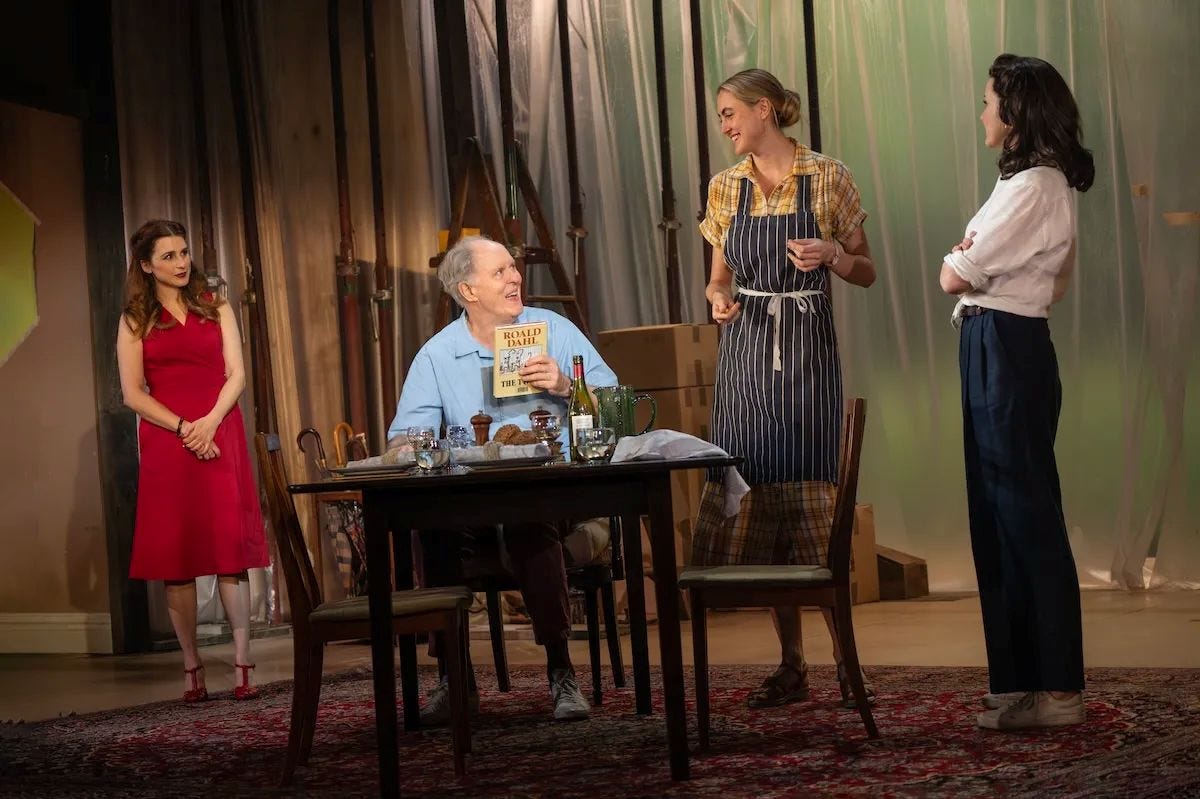
Aya Cash, John Lithgow, Stella Everett, and Rachel Stirling in Giant. Photo: Joan Marcus
For several decades now, ever since superstar children’s author Roald Dahl outed himself as anti-Israeli, any savoring of his work has been something of a guilty pleasure – for adults, anyway. Children continue to lap up his playful crypto-sadism (pushed to an extreme in the Netflix adaptation of Matilda the Musical), and grownups, happy to support reading in any form, have tended to stay mum. Meanwhile, publishers have hustled to tidy up Dahl’s more egregious slurs.
Mark Rosenblatt’s workmanlike script sketches a pivotal afternoon in the summer of 1983, when the Literary Review published a book review by Dahl in which he likened Israelis – then at war with Lebanon – to Nazis. As literary scandals go, this one created enough of a stir that Dahl’s U.S. publisher, Farrar, Straus and Giroux, felt compelled to assign an emissary to try to tamp down the furor – the corrective effort no doubt motivated in part by the company’s concern for its bottom line. By this point Dahl had published nearly a dozen children’s books – all bestsellers – and the pub date for The Witches was fast approaching.
In the play, the task of damage control is assigned to fictional FS&G sales director Jessie Stone (Aya Cash, forthright, with a determined intelligence). You might note a certain backstory packed into Stone’s last name? Dahl – with author Rosenblatt pulling the strings – certainly does.
John Lithgow, with his odd mix of imposing stature and piquant, almost babyish features, is an apt pick to play the monstre sacré. Sequestered in his ancestral Buckinghamshire manse (undergoing renovations, which conveniently allow designer Bob Crowley a slapdash set), the celebrated author is line-editing galleys with his British publisher, Tom Maschler (Elliot Levey) – a highly unlikely scenario.
Hovering solicitously is his mistress-turned-fiancée, Felicity Crosland (Rachel Stirling), whom Crowley, doubling as costume designer, has mysteriously got up to resemble a mid-’40s Hedy Lamarr. Prepared to devote her full attention to the care and feeding of a cantankerous genius (as many women of that era did), “Liccy” is metaphorically rolling up her sleeves for a massive dual makeover.
All three tag-team Dahl, trying to get him to issue some sort of retraction. Lending further counsel are two servants perhaps meant to represent the prole perspective: a groundsman (David Manis), who offers what amounts to a hat-wringing pep talk – Dahl interprets his support as folksy gospel – and a strapping young live-in cook, Hallie (Stella Everett), who’s apparently on permanent call, charged with providing Dahl and the committee of complainants with a steady stream of comestibles.
Dahl toys at treating Hallie as an equal: he asks her advice and she plays along, withholding judgment, as long as she is able. The audience may well lack her patience, however, since we have a pretty good idea of where all this badinage is headed. Chastened, badgered, and bribed by his familiars (you do not want to linger over Dahl’s notion of a good-behavior reward in the boudoir), the beleaguered author remains unrepentant, happy to play cat to his coterie of mice.
How and why, bottom line aside, do his familiars put up with him? In the script, Dahl’s raw antisemitism does take a while to bubble to the surface: he sits back and strategizes, like a malevolent child or evil gnome, before perversely doubling down. It’s clear from the start, though, that his natural bent will assert itself.
The play, though timely (the core issue is regrettably an evergreen), is not especially insightful or transformative; nor is the storyline exactly a cliffhanger. Dahl may appear to vacillate, but in essence his stance never varies. Push come to shove, he’ll exercise a child’s fall-back strategy: the power to balk (a.k.a. “You can’t make me”). Dahl is the type to savor every morsel of attention directed his way, even when negative, so the only thread of tension is how long he’ll sustain the pretense of going along to get along. At nearly 2 1/2 hours of running time, the answer is: Too long.
Technically, Lithgow’s portrayal may be a tour de force, but the play as a whole falls short of sensational. As directed by Nichalas Hytner (who informally commissioned it), Giant is a pointillistic study of a character ultimately not all that intriguing. Premise proven and then some: that Dahl, despite his literary gifts, was unapologetically prejudiced, not to mention an egotist and bully. At a time when we have plentiful examples of this personality type splashed across the headlines daily, why go to the trouble of schlepping to a theatre to endure a tiresome iteration of parallel bad behavior dredged up from the past?
Details: Giant, to June 28