**** Girl, Interrupted
Simultaneously whitewashed and begrimed

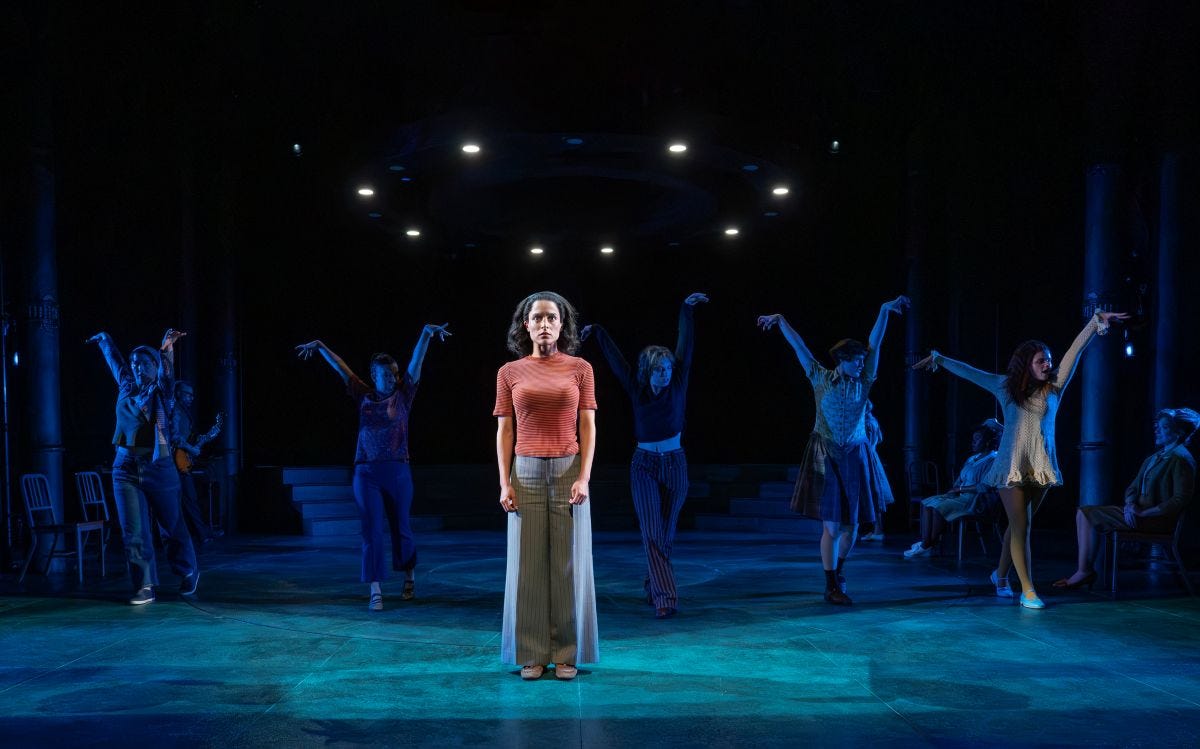
Juliana Canfield (center) and company in Girl, Interrupted. Photo: Joan Marcus
As a fellow teen suicide-manquée of the late ’60s, I had issues with Susanna Kaysen’s puzzlingly opaque memoir when it came out in 1992 and now find minor fault with the not-officially-a-musical production at the Public Theater. A musical is what this work assuredly is: chamber version, perhaps, or at minimum a song cycle. Foremost among its merits are the evocative melodic breaks composed by Aimee Mann, sensitively arranged by Todd Almond, and accompanied on guitar by Manoel Felciano (who is listed among the cast as “The Male Presence”).
As adapted by Martyna Majok and directed by Jo Bonney, Kaysen’s narrative has been set firmly (if perhaps erroneously) in place by the scenic design collective dots. Just how grim and punitive was McLean — Boston’s go-to psychological repair shop since 1811 — in that particular era? The set, a subterranean study in seaweed greens, resembles the sunken hold of a decommissioned cargo ship. Lighting designer Heather Gilbert keeps the recesses dim, in such a way that performers not “on” can fade into the shadows (as unstable patients tend to do when not acting out); actors ease into the spotlight individually to deliver their designated numbers.
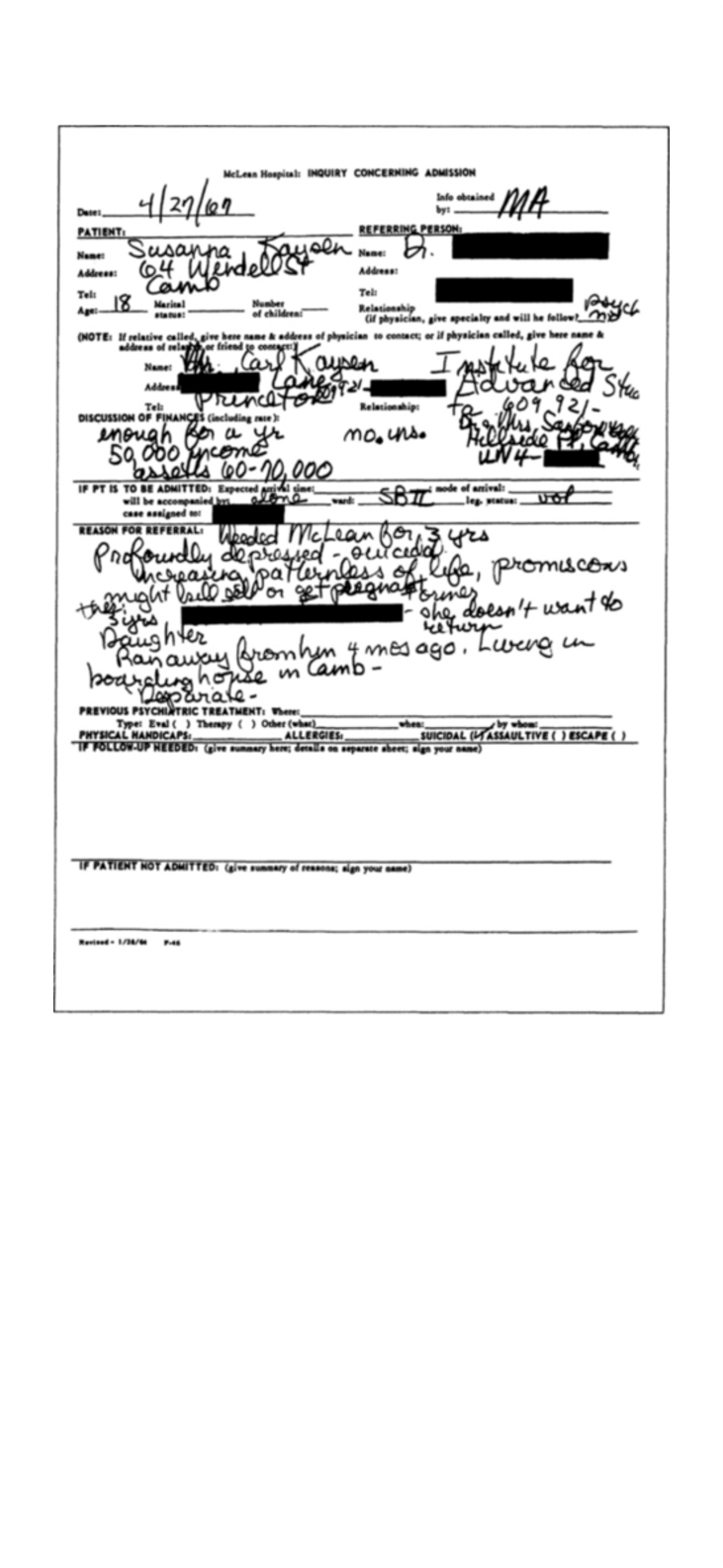
In an explanatory preface and then throughout, Susanna (Juliana Canfield) presents as a tidily coifed (bouffant flip by hair designer J. Jared Thomas) exemplar of middle-class, midcentury normalcy. Kaysen’s admission paperwork (see below) presents a different story: that of a runaway, a rebel. So demerits from the get-go for authenticity, despite Canfield’s well-calibrated delivery.
King Princess plays the self-proclaimed “psychopath” Lisa (Angelina Jolie’s breakout role in the film) with all due intensity, which is to say: She maintains a beguiling mask of superficial insouciance atop internal roiling. Sally Shaw is a heartbreaker as Polly, whose disfiguring burns – not shown, but palpable – were her own doing. Gabi Campo as Mexican meth-addict Tori (a transient here) seizes the spotlight all too briefly and makes optimal use of it. As Susanna’s roommate, Grace (the secondary through-character), Mia Pak is the embodiment of empathy – right up to Grace’s scatological psychotic break.
It’s a pity that the pair’s first duet serves mainly to name-drop McLean’s notorious alumni, including well-known literary lights Sylvia Plath and Robert Lowell. Both Susanna and Grace aspire to become writers. Would any halfway literate therapist of that era (Emily Skinner plays frozen-in-amber Dr. Wick) dismiss Susanna’s dream as impossible and recommend instead a career as a dental technician? Also, when did an unexplained but reiterated “marriage proposal” become a get-out-of-semivoluntary-confinement-free card?
The fadeout represents a Dorothy-in-Oz denouement (“You always had the power, my dear . . .”). Like its predecessors in print and onscreen, ultimately this latest rendition of Girl, Interrupted raises more questions than it answers.
Details: Girl, Interrupted, to July 12