
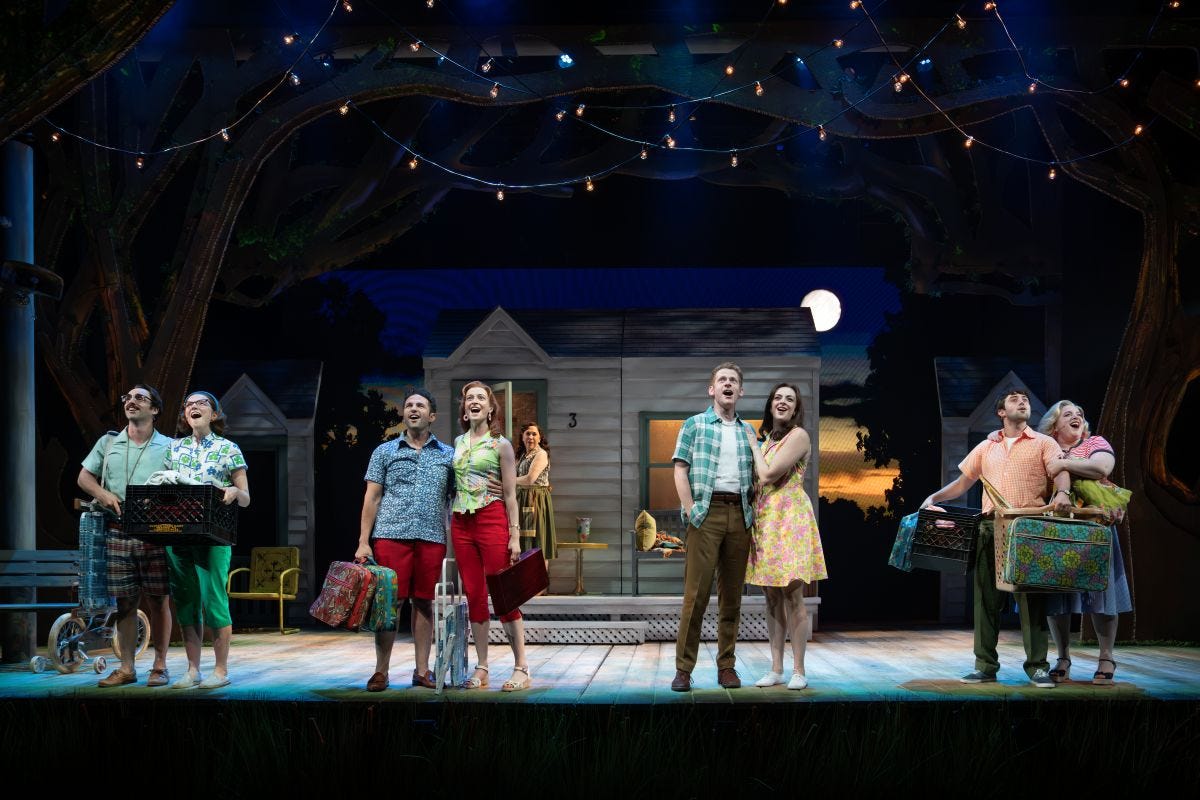
The cast of A Walk on the Moon. Photo: Joan Marcus
Any attempt to single out the merits of this mishegoss musicalization of the standout 1999 movie (Pamela Gray gets writer credit on both) presents a challenge. There aren’t many.
To synopsize the plot per the stage version: It’s August 1969. As the nation thrills to the prospect of the moon landing and rumors stir about a certain modest rock festival coming to the nearby town of Woodstock (the script is nothing if not faux-ingenuous), a quartet of couples settle into their summer routine at a Jewish bungalow colony in the Catskills. The highpoint of the entire production is hearing Tovah Feldshuh (not among the live cast, alas, though she had a key role in the film) issue the usual pre-curtain warning and then various interstitial updates in the audiotaped persona of Mrs. Fogler, camp owner. Feldshuh gives the voiceovers her special spice. Otherwise the abbreviated script amounts to thin, cliché-ridden gruel.
The plot as redacted: After sixteen years of marriage, resulting in a fifteen-year-old daughter – the math announces itself, needing none of the repetitious allusions – Pearl Kantrowitz (Talia Suskauer), at age 31, is feeling unfulfilled. Pearl and her trio of cronies are aware of Betty Friedan, but dismissive: They play hot potato with a copy of The Feminist Mystique as if it were an incendiary device.
But Pearl has a case of wandering eye: She senses that something is missing from her life, and it just might take the weathered yet buff form of “blouse man” Walker Jerome (Sam Gravitte), an itinerant merchant making the rounds of the various woodland compounds. Tempted to spice up her image (and marriage), Pearl takes a tentative step by buying a tie-dye T-shirt (torch-y song break: “What Tie-Dye Can Do”). Her electrician husband, Marty (Max Chernin), finds the garment not just laughable but repugnant: “This just doesn’t do it for me.”
Ticked off by the rebuff and the fact that Marty won’t take time off work to join the community in watching the televised landing, Pearl opts for an extramarital adventure – and now it’s time for set-and-video designer Tal Yarden to flood the high-school-caliber set with morphing acid-era projections.
Groovy. But why does Pearl’s new inamorato, roughly her vintage, rave about Kerouac (not exactly cutting edge by then; Kesey, more likely) and yearn to hit the road for California (read The Haight)? Gray’s script is a veritable wikipedia of late ’60s clichés, be they square or wannabe hip.
Suskauer is a fine singer and will surely advance to more sophisticated roles. As daughter Alison, who’s just beginning to dabble in rebellion, Sophie Pollono shows promise. One demerit, though: No dialogue coach is credited, so apparently Pollono has chosen on her own to adopt an exaggerated Brooklyn accent which illogically exceeds that of her forebears – such as Andrea Burns, regrettably roped in but solid as always as Alison’s wise-with-age bubbe (Feldshuh’s role in the film). Oscar Williams, playing a starter boyfriend with rock-star aspirations, also makes good use of his stage time.
The cast as a whole deserves better material. The overall sense is that the creative team opted to prioritize ambiance – we’ve observed this particular socioeconomic tranche in far-superior classics such as Dirty Dancing – over emotional verity. Pricklier aspects of the filmscript have been sanded over, and Annmarie Milazzo’s relentlessly rhyme-y songs can’t hold a candle to the ’60s songbook classics that underscore the original.
Anna Karenina this is not. A middle-class housewife risks her family’s well-being for a fling – then what? Where the film managed to bring depth and ambiguity to a traditional marriage threatened by changing mores, the musical’s denouement will try to convince you that, one way or another, everything’s going to end up just peachy. A new age has clearly dawned when the couple’s nine-year-old son (cast closer to six) is finally permitted to chant the full “Chuck chuck” variation of the mid-’60s hit naming-game song, “banana fana fofana.”
Banana fana fo-feh.
Details: A Walk on the Moon, to August 22